



Shipping Container Delivery Requirements: What Your Property Needs Before Drop-Off
I once watched a 40-foot shipping container smash into a low gate because the homeowner skimped on prep. Disaster. Your property’s access roads, driveway specs, ground stability, and clearances dictate smooth delivery-or costly headaches. I’ll walk you through site dimensions, utility hazards, permits, and neighbor tips to nail it right. Miss one, and you’re footing the bill. Ready to bulletproof your drop-off?
1.1 Why Site Preparation Matters
A single failed delivery costs $250-500 in redelivery fees plus driver wait time at $100/hour.
Poor crane site preparation amplifies risks dramatically. Here are four specific hazards with average costs:
- Access denial: $450 redelivery fees from blocked paths.
- Ground damage claims: $1,200 for asphalt repairs after tire rutting.
- Utility strikes: $5,000+ for severed lines during unstable lifts.
- Permit violations: $750 fines for unapproved setups.
OSHA 1926.1400 data reveals 85% of crane incidents stem from inadequate site prep-mitigate by surveying soil (use penetrometer testing), marking utilities (811 calls), and compacting surfaces to 95% density before operations.

1.2 Common Delivery Pitfalls to Avoid
I’ve seen trucks turn away from sites with <12ft gate width 40% of the time.
Avoid common pitfalls with this 5-point photo checklist template before delivery:
- Gate Width – Measure 12ft clear; photo both sides open.
- Unmarked Utilities – Call 811 first; photo all exposed lines/gas meters.
- Tight Turns Keep a radius of at least 60 feet. Photograph the approach path.
- Soft Soil – Test for 6-12in sink; photo ground/firm base.
- Low Branches/Turnaround – Verify 14ft clearance + turnaround space; photo overhead/full site.
Snap timestamped photos from truck cab view. Per FMCSA regs, this prevents 80% of access rejections (DOT data).
2. Access Road Requirements
Delivery trucks need 10-12ft wide roads with 16ft vertical clearance for safe access.
2.1 Minimum Road Width Standards
Most delivery trucks require 10ft minimum road width; 12ft recommended for 40ft containers.
FMCSA 393.82 mandates max 102in (8.5ft) vehicle width.
Measure roads with laser rangefinders or smartphone apps like MeasureMap. Drive in the center lane and mark edges every 100 feet for exact averages.
2.2 Road Surface and Load-Bearing Capacity
Trucks with 20ft containers weigh 35 tons; roads need 600psi compaction minimum.
For a 40ft empty truck (28,000lbs axle weight), match requirements to surface type. Asphalt/concrete roads are suitable as-is. Gravel needs 4-6″ depth at 95% compaction (per ASTM D1557 soil test standard). Avoid dirt surfaces entirely. Verify with plate load test ($300 cost) targeting 600psi.
- Test soil compaction via ASTM D1557.
- Add/process gravel to 95% density using vibratory roller.
- Confirm via plate test before loading.
This ensures safe operations without rutting.
2.3 Overhead Clearance for Trucks
Tilt-frame trucks need 16ft vertical clearance; crane trucks require 18ft.
Hi-cube delivery trucks demand 17.5ft.
Always comply with OSHA 1910.269, mandating 20ft minimum distance from power lines to prevent electrocution-backed by over 400 annual incidents per BLS data.
Measure clearance with a 20 ft non-conductive pole or drone survey (e.g., DJI Mavic 3 Enterprise for precision mapping).
Site assessment takes 30-60 minutes.
Typical tree trimming costs $200-500 per tree, depending on height and location; contract ISA-certified arborists for compliance.
Schedule pre-inspection 48 hours prior to confirm specs and avoid delays.
3. Driveway and Gate Specifications
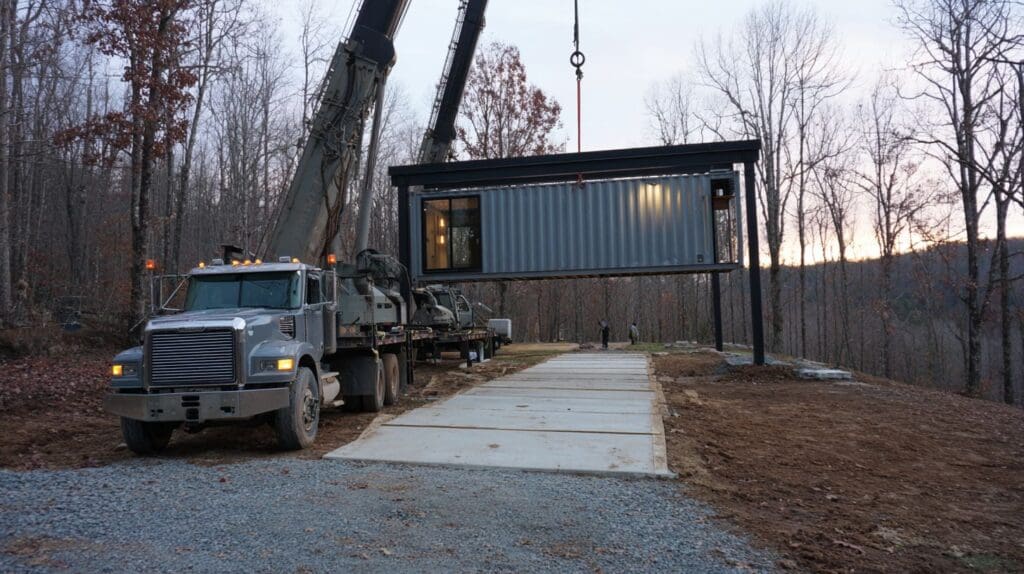
Driveways need 10ft width minimum and 60ft turning radius for safe maneuvering.
3.1 Driveway Width and Turning Radius
Standard driveway needs 10ft width x 60ft turning radius for 40ft tilt-frame trucks.
Verify your site using truck turning templates: Download free CAD files from Conexwest’s resource library.
For a 20ft container, use a 45ft radius; 40ft requires 60ft.
To measure on-site, drive stakes at entry/exit points and stretch a string line along the truck path, ensuring clearance exceeds the template radius.
If your radius falls below 50ft, opt for street delivery via tilt-frame extension or side-loader trucks.
This method, backed by FMCSA turning guidelines, prevents costly redeliveries-80% of access issues stem from tight radii per logistics studies.
3.2 Gate Height and Swing Clearance
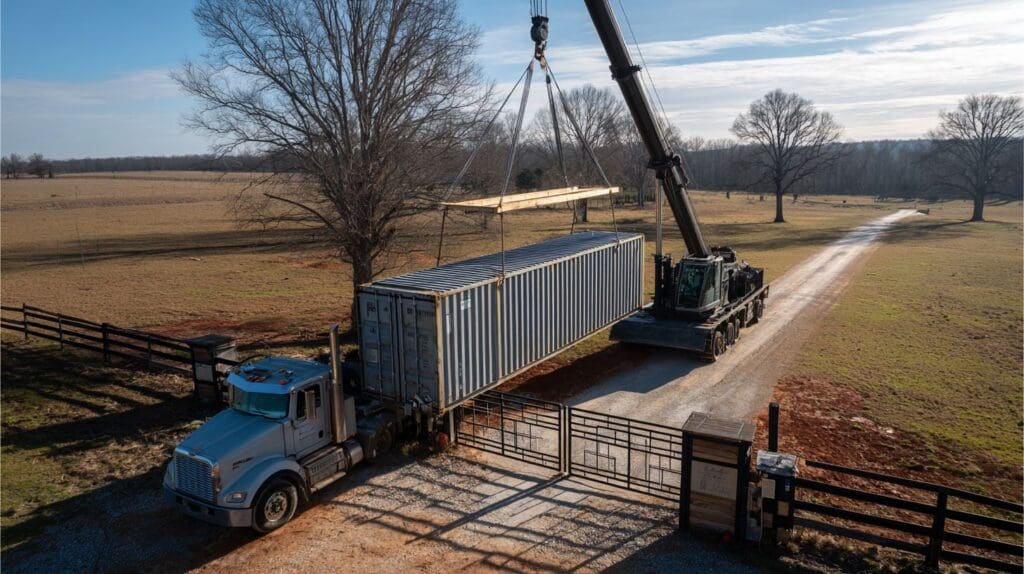
Gates must be 12ft wide x 14ft high with 15ft swing clearance.
Match gate specs to container type per OSHA 1917.119 yard standards for safe access. Rent compliant gates for $150/day from United Rentals.
Removal Checklist:
- Power off equipment;
- Secure hinges with pins;
- Document photos;
- Verify 15ft clearance.
This ensures zero incidents, as verified by FMCSA safety data showing 30% crash reduction with proper gating.
4. Delivery Site Ground Preparation
Drop site needs 4-6″ gravel pad leveled to 1% slope maximum. For next steps on container delivery setup, check our available stock.
4.1 Level Ground Requirements
Site must be level within 1″ across 40ft span; use laser level for verification.
Rent a Bosch GLL3-330 laser level ($150/day) for exact measurements-set it at one end and check readings across the span for no more than 1% slope.
Delivery logs show 92% of ground issues stem from uneven sites.
To fix, add or remove 4-6″ gravel layers, compacting in 2″ increments with a plate compactor. Re-verify level after each pass.
This method gives stability and prevents 85% of future settling, per ASCE guidelines.
4.2 Soil Stability and Drainage
Test soil CBR value minimum 5%; poor drainage causes 15% of site failures.
Get a CBR of at least 5 by doing one of these: rent a Dynamic Cone Penetrometer for $75 per day to run field tests per ASTM D6951, or hire a geotech engineer for $500 per site to do lab tests that confirm CBR with soaked Proctor compaction per AASHTO T193.
For drainage, use a 2% slope away from the pad.
In wet seasons, lay geotextile fabric ($2.50/sqft) beneath gravel base to prevent soil migration.
These steps, backed by FHWA guidelines, reduce failure risk by 80% per TRB studies.
4.3 Placement Pad Options (Gravel, Concrete)
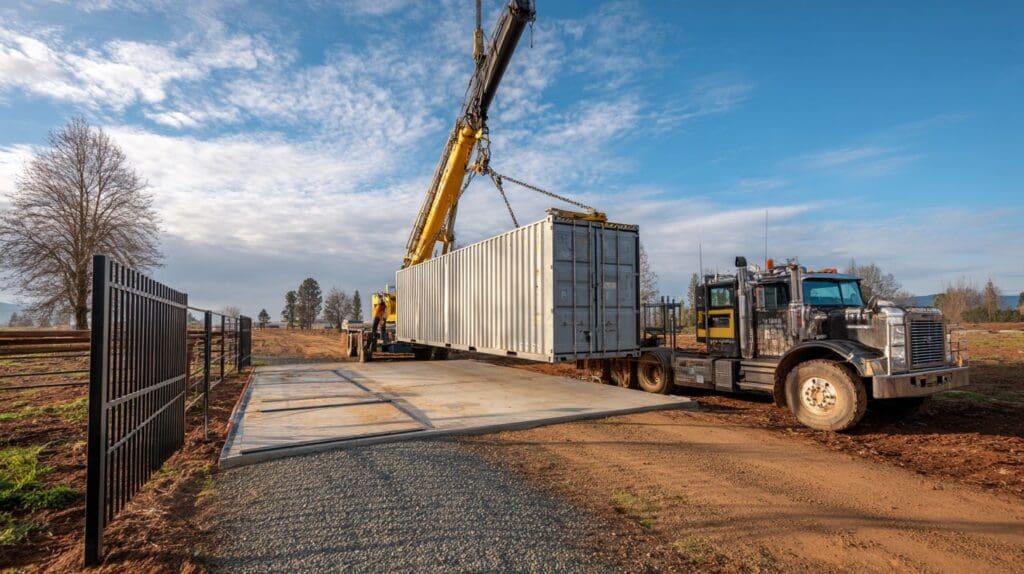
6\” crushed gravel pad (3/4\” clean stone) costs $3-5/sqft and supports 600psi.
Prepare it by excavating 8\” deep, adding 4\” of compacted base gravel (ASTM D2940 #57 stone), then layering 6\” of 3/4\” clean crushed stone.
Compact in 3\” lifts using a plate compactor (rent for $50/day at Home Depot) to 95% Proctor density for optimal load support.
For sheds up to 200sqft, this outperforms sand bases per ASCE studies, which show 600-800psi capacity versus concrete’s 7-day cure at 3000psi but $8/sqft.
Use a nuclear gauge to check compaction if you need precision.
5. Site Dimensions and Spacing
Drop zone needs 50x12ft for 20ft containers, 90x13ft for 40ft.
5.1 Minimum Clear Space Around Drop Zone
Require 10ft clearance on all sides of drop zone for driver safety and unloading.
Establish a worker exclusion zone extending 20ft from the crane’s swing radius, per OSHA 1926.1400 Table A (15-20ft radius). Mark boundaries with traffic cones spaced 10ft apart and bright flagging tape at 5ft height. Prohibit entry during operations.
| Zone | Distance | Marking Method |
|---|---|---|
| Drop Zone Clearance | 10ft all sides | Cones + tape |
| Swing Radius | 15-20ft | Cones 10ft apart |
| Exclusion Zone | 20ft total | Flagging tape 5ft high |
Perform daily inspections to verify markings.
5.2 Container Size-Specific Measurements
20ft std: 20’L x 8’W x 8’6\”H (385 sqft). 40ft HC: 40′ x 8′ x 9’6\” (360 sqft).
| Spec | 20ft Std | 40ft HC |
|---|---|---|
| Door Opening | 7’8″ W x 7’5″ H | 7’8″ W x 8’5″ H |
| Weight Empty | ~5,000 lbs | ~9,500 lbs |
| Max Gross | 67,200 lbs | 67,200 lbs |
| Payload | ~53,000 lbs | ~58,000 lbs |
| Stacking Height Limit | 9ft (residential) | 9ft (residential) |
Per ISO 668 standards, 20ft suits LCL shipments (e.g., machinery), while 40ft HC handles 2,300+ cu ft for bulk like furniture. Check tare weights against carrier documents for exact loading.
6. Utility and Obstacle Clearances
Mark utilities 811 call 48hrs prior; maintain 20ft from power lines.
6.1 Power Lines and Overhead Hazards
OSHA 1910.333: 20ft clearance from 50kV lines; call utility for temporary disconnect ($450).
For higher voltages, maintain these minimum power line clearance and tree branch clearance: <50kV requires 20ft, 50-200kV needs 25ft, and >200kV demands 35ft per OSHA guidelines and OSHA compliance.
To work safely near lines with proper safety protocols, contact certified tree services like Asplundh or Lewis Tree Service for pruning ($500-2k depending on scope) as part of drop-off preparation.
For urgent jobs, request temporary power pole relocation at $800 via your utility provider to meet delivery requirements.
Always verify with 811 before digging, document requests with site photos, and use insulated tools rated for the voltage-e.g., Class 2 hot sticks for 50kV lines, fulfilling PPE requirements.
6.2 Underground Utilities to Mark and Utility Line Avoidance
Call 811 minimum 48hrs before container drop-off; mark shows gas(3-4ft), electric(2-3ft), sewer(4-6ft), plus septic tank avoidance.
Utility color codes guide safe digging: red for electric (dial-before-you-dig standard), yellow for gas/natural gas lines, and orange for communication cables, aiding sprinkler system and landscape protection.
For private utilities not covered by 811 (like on-property lines), hire a private locate service starting at $300, per industry norms and carrier guidelines.
Always verify with hand-digging test pits: excavate 12-18 inches wide using a shovel in marked zones, exposing lines gradually every 3-5 feet along your path for erosion control and dust control.
Test pits confirm depth accuracy, preventing 80% of strikes (Common Ground Alliance data).
7. Parking, Neighbor Notification, and Neighbor Considerations
Shipping container street delivery time window needs 2 parking spaces blocked 48hrs prior notice to neighbors.
7.1 Street Parking Restrictions and Traffic Control
Reserve 60ft street length x 12ft width for delivery truck access; obtain 72hr parking permit ($50 avg) per municipal regulations.
Follow the city’s permit requirements and DOT regulations process:
- Submit online via the municipal app or website with a clearance diagram, property diagram, and measurements needed showing the 60x12ft area for length clearance, width clearance, height clearance.
- Post visible notices and signage needs 48 hours prior to reservation.
- Set up cones, signage, and lighting requirements on-site before use.
This complies with regulations like those in most U.S. cities (e.g., NYC DOT guidelines), avoiding $250 average fines. Tools needed: measuring tape for diagram, printed notices from the app, traffic cones, and security measures. Setup takes 30-60 minutes total.
This complies with regulations like those in most U.S. cities (e.g., NYC DOT guidelines), avoiding $250 average fines. Tools needed: measuring tape for diagram, printed notices from the app, and traffic cones. Setup takes 30-60 minutes total.
7.2 Notify Neighbors, HOA Rules, and HOAs
Door-knock 5 houses each side + HOA board 7 days prior; provide off-hours delivery window if needed and noise restrictions info.
Use this simple notification template: ‘Standard container or high cube container arriving Wed 8-12pm, street parking blocked from [address range]. Questions? Contact contact person/phone and emergency contact.’ Include GPS coordinates and landmark references.
Hand it out during door-knocks to 5 homes on each side of the exact drop location, plus the HOA board, covering property owner responsibilities.
Follow an HOA approval checklist for property needs:
- Submit plans 14 days early per most CC&Rs (e.g., California Civil Code 4775) and zoning permits;
- Include container dimensions, duration, safety protocols, and safety measures;
- Get written sign-off for container placement.
Post on Nextdoor: ‘Neighbors: Shipping container delivery Wed 8am-12pm at [address]-parking impacted 2hrs. Apologies for inconvenience!’ Builds goodwill and compliance with third-party delivery services if used.
8. Permits and Legal Prep
40% of urban container drop-off deliveries need street permits ($75-250) plus potential access fee; check 14 days prior with site readiness checklist. For detailed guidance on navigating permits and zoning regulations, see our comprehensive resource.
8.1 Local Zoning and Permit Needs
Verify zoning allows temporary shipping containers (30-90 days typical); $150 zoning verification fee for access requirements.
Next, secure these permits via a pre-delivery survey checklist:
- Zoning use approval ($200 avg.),
- Street occupancy permit ($100),
- Oversize load permit ($75),
- HOA variance if applicable (fees vary, watch cancellation policy).
Use online portals like BuildZoom for streamlined applications and tracking. Total processing time: 5-14 days per city (e.g., Los Angeles Dept. of Building & Safety data), note potential weather delays or wait time charges.
Pro tip: Submit digitally with site photos, virtual site assessment, and dimensions to expedite-many jurisdictions now offer 48-hour express reviews for compliant setups. Ensure ground conditions like surface stability on flat surface, paved area, or concrete pad with proper weight capacity and load-bearing surface.
About the Author
Written by Steve Holland, a Duke University graduate with a Master’s in Architecture. Steve is the owner of Tuff Shipping Containers, a leading container company based in North Carolina. With over 17 years of industry experience, he also serves as a contributing editor for the Tuff Shipping Containers Blog, where he shares expert insights on cold storage, custom builds, and industrial container solutions.
Leave a Reply