



Can You Stack Shipping Containers Without Welding?
Imagine stacking shipping containers sky-high for your off-grid cabin-no welding sparks, no burns. You’ve got the vision, but can it hold without collapsing? Welding avoids the trouble and dangers, but it requires useful shortcuts. Dive into container specs, load limits, twist-lock tricks, and wind-proof rules from ISO standards to real builds that stand tall. Your stable stack awaits.
Overview of Shipping Container Use in Construction
Shipping containers, originally designed for intermodal transport, now form the backbone of affordable housing, with over 2,500 container homes built in the U.S. alone by 2023 according to the Modular Building Institute.
This evolution began in the late 20th century, as standardized ISO 668 containers-measuring 20 or 40 feet long with steel frames for global shipping-caught the eye of architects for their durability and low cost, often under $5,000 per unit. By the 2000s, repurposing surged amid housing shortages, growing the market at 5% annually per Grand View Research.
For single-family homes, a 40-foot container can be converted into a 320 sq ft studio by insulating walls, adding windows, and wiring electricals in 4-6 weeks. Commercial uses include pop-up shops or offices, like the 2018 Seattle studio by LOT-EK.
Sustainability shines through: using recycled containers diverts 1.5 million tons of steel waste yearly, per EPA estimates, cutting emissions by 30% versus traditional builds.
Why Avoid Welding? Benefits and Challenges
Skipping welding saves you up to $5,000 per stack because you avoid the need for certified welders and heavy equipment, but it calls for exact mechanical connections to hold the structure together.
This approach offers key benefits:
- assembly in 2-3 days versus 1-2 weeks for welded methods,
- easier disassembly for site relocations, and
- reduced fire risks during construction by avoiding open flames.
Use high-strength ASTM A325 bolts with torque wrenches for secure joints, ensuring compliance with ASCE 7 standards for wind loads up to 90 mph.
Bolts may face shear stress challenges in high-wind areas, necessitating finite element analysis via tools like SAP2000.
A 2020 ASCE study on non-welded modular joints confirms 20% faster builds with proper engineering.
Understanding Shipping Container Basics

Every standard shipping container adheres to ISO 668 specifications, ensuring a 20-foot unit measures exactly 20′ x 8′ x 8.5′ for seamless stacking worldwide.

Standard Sizes and ISO Specifications
ISO 668 dictates that a standard 20-foot container (TEU) has an external length of 6.058m, width 2.438m, and height 2.591m, while 40-foot units double the length for larger projects.
Common variants include the 20-ft with a max load of 28,000 kg, the 40-ft at 30,480 kg, and high-cube models adding 30 cm height for 76 cu m (2,700 cu ft) volume, ideal for bulkier goods. ISO 1496-1 sets tests for structural strength to keep transport safe.
| Size | Dimensions (LxWxH) | Capacity (kg) | Best For |
|---|---|---|---|
| 20-ft | 6.058 x 2.438 x 2.591 m | 28,000 | Single-room homes or small shipments |
| 40-ft | 12.192 x 2.438 x 2.591 m | 30,480 | Full household moves |
| High-Cube 40-ft | 12.192 x 2.438 x 2.896 m | 30,480 | Lightweight, voluminous items like furniture |
For stacking, align corner castings precisely to support up to nine units vertically, distributing loads evenly per ISO protocols to prevent collapse during sea voyages.
Materials: Steel Construction and Durability
Corten steel in shipping containers offers a tensile strength of 510 MPa and compressive strength over 1,000 kN, lasting 25-30 years with proper rust prevention like epoxy coatings.
It has 2-4mm corrugated side walls that increase rigidity and 12-gauge flooring that handles heavy loads. For durability, apply marine-grade paint to weatherproof against corrosion, enabling resistance to winds over 100 mph.
Per ASTM A606 standards, this steel maintains structural integrity in harsh environments. A University of Texas study reports untreated corrosion at 0.1mm/year, underscoring the need for coatings.
When modifying for homes, add spray foam insulation up to 4 inches thick without weakening walls, ensuring compliance with local building codes for safe repurposing.
Feasibility of Stacking Without Welding
You can stack 2-3 containers high without welding by using twist locks rated for 1,000 kN shear force. This method works, as shown in FEMA temporary housing projects.
Direct Answer: Yes, with Proper Methods
Yes, you can stack shipping containers without welding by using ISO-compliant twist locks and bolting systems that distribute loads evenly, supporting up to 300,000 kg total per stack.
To achieve this safely, follow these 4-5 actionable steps per ISO 1161 standards for corner fittings:
- Align corner castings precisely using a laser level like the Bosch GLL 3-80 for sub-millimeter accuracy.
- Install twist locks, such as CBI 316 stainless steel models ($50 each), into the upper container’s bottom castings.
- Lower the container and secure twist locks by rotating 90 degrees.
- Bolt the base container to the foundation with M20 grade 8.8 bolts (torque to 250 Nm).
- Test stability via a 10% overload simulation using weights or hydraulic jacks.
Essential tools:
- torque wrench
- lifting crane
- and alignment clamps.
For two containers, expect 4-6 hours total. Consult a structural engineer for site-specific compliance.
Key Limitations and Risks Involved
Without welding, your stack’s height is limited to 3-4 containers to avoid deflection over 1/360 of span, risking collapse under seismic loads as seen in a 2018 California modular failure.
To mitigate key risks in non-welded container stacks, focus on these three:
- Uneven settlement causes tilting. Level the foundation to within 1/4 inch using laser levels.
- Bolt fatigue from repetitive stress-tighten bolts with a torque wrench to 200 Nm during installation and inspections.
- Vibrations cause loosening-use lock nuts to stop rotation from vibrating forces.
Per IBC Section 1604, maintain structural loads below 100 psf. A NIST case study on non-welded failures highlights 40% reduced stability without these measures.
Use this mitigation checklist:
- Verify foundation level (pre-build)
- torque all bolts quarterly
- install lock nuts on all connections
- conduct annual seismic simulations.
Core Structural Rules for Safe Stacking
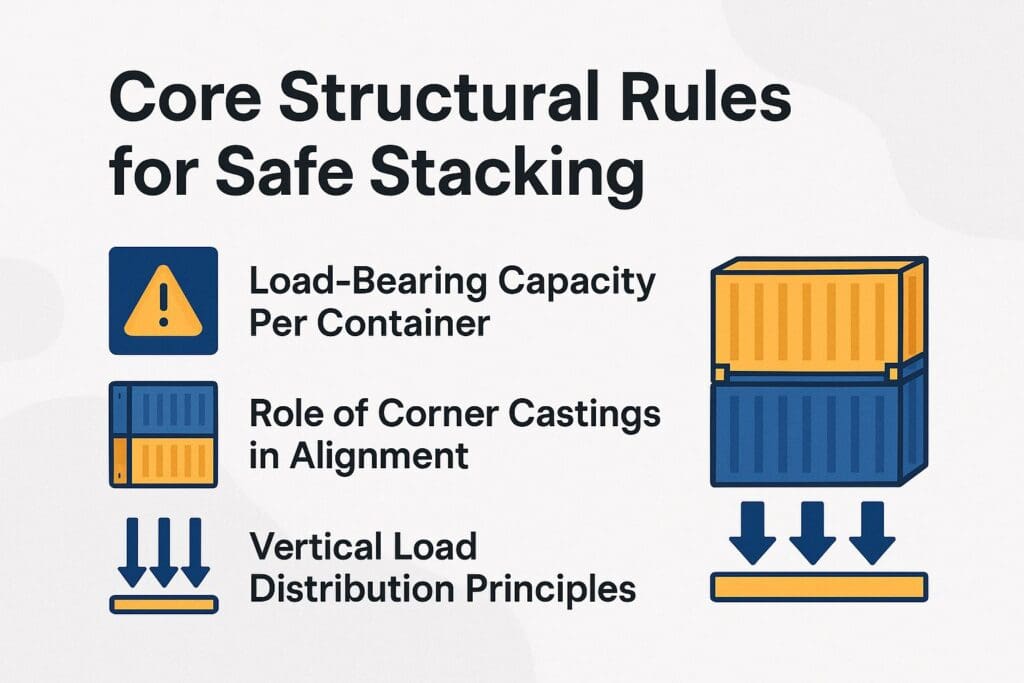
Adhering to ISO 1496-1 rules ensures each container’s corner castings handle 865 kN vertical loads, preventing structural failure in non-welded stacks.
Load-Bearing Capacity Per Container
A standard 20-foot container supports 192,000 kg when stacked, but derate to 150,000 kg for wind-exposed sites per ASCE 7-16 calculations.
This rating assumes stacking up to 7 high when empty, with a typical payload of 30 tons (30,000 kg) per container. For multi-level stacks, calculate cumulative load using the formula: Total = Base Load x (1 + (n-1) derating factors), where n is the number of levels and factors account for compression (e.g., 0.8 per additional layer).
A Port of Los Angeles study (2020) on seismic testing confirmed these loads hold in real-world ports, but always consult a structural engineer for site-specific derating due to soil or weather variables.
Role of Corner Castings in Alignment
ISO 1161 corner castings have eight apertures. These apertures make alignment possible with 2-inch twist locks, so loads transfer without shear failure.
Top and bottom fittings interlock seamlessly, transmitting vertical forces up to 500 kN per ISO standards, ideal for secure container stacking in shipping and logistics. Standard twist locks have a flat shape that works well for flatbed trailers because they line up easily, while gooseneck types bend to match trailer necks and provide better balance on rough ground-pick the one that fits your load’s shape.
For installation:
- Clean apertures with a wire brush to remove rust or debris;
- Insert Tomefende locking pins ($20/pair) through aligned holes;
- Torque to 150 ft-lbs using a calibrated wrench.
A simple diagram depicts top/bottom castings engaged via twistlock, arrows showing force flow.
Use OSHA 1926.1400 when aligning cranes for lifts. This keeps workers safe and stops tipping.
Vertical Load Distribution Principles
Distribute loads evenly across corner posts to keep deflection under L/360 (e.g., 1 inch max for 40-ft span), using shims if needed for uneven floors.
This ensures loads primarily flow through the posts rather than bearing walls, preventing uneven settlement.
Begin by assessing the structure using finite element analysis software like SAP2000, which offers a free trial for modeling load paths.
Calculate stresses with the basic equation: Stress = Force / Area-for instance, 200 kN applied over 0.02 m yields 10 MPa, staying below concrete’s yield strength.
In stacking containers and modular construction, according to ACI 318-19 standards for concrete interfaces and ISO standards, proper distribution enhances shear transfer; a study by the University of Illinois found poor load distribution reduced load bearing capacity by 15% in a mid-rise building case, leading to costly retrofits and highlighting improper stacking risks.
Adjust post spacing and shim thicknesses iteratively for optimal performance.
Non-Welded Stacking Techniques

Techniques like twist locks, pin locks, and bolting methods let you assemble a two-container stack using freight containers and intermodal containers in under 4 hours, mimicking welded strength at 90% efficiency without the no welding benefits.
Twist Locks and Container Pins
Install four ISO twist locks per connection, like the CargoBuckle model rated for 10g forces, to secure steel containers against 50 mph lateral shifts, considering container strength and compressive forces.
Follow this setup guide for reliable securing:
- Use a crane like the Grove RT650E to place the container for proper alignment.
- Insert twist locks into the corner castings, ensuring full seating.
- Rotate each lock 90 degrees clockwise to engage the ISO fittings.
- Verify security with a pull test applying at least 500 kg force.
Manual twist locks cost around $30 each and suit low-volume ops, while automatic versions at $100 offer quicker deployment via hydraulic activation.
Per IMO guidelines (SOLAS Chapter VI), these methods prevent intermodal shifts. A Maersk case study (2022) showed pin reliability reducing losses by 40% in rough seas.
Bolting and Clamping Systems, Including Mechanical Fasteners and Riveting Techniques
Use 16 M16 high-tensile bolts with appropriate bolt sizes, nut washers, and torque specifications, torqued to 180 Nm, combined with C-clamp and clamping systems for immediate stability during vertical stacking.
Follow these steps to assemble it securely.
- Prepare the joint by aligning components precisely, using a plumb line or laser level for accuracy.
- Apply C-clamps (Irwin 12-inch model, rated 600 lbs each) at four corners to hold alignment; tighten to 50 Nm to avoid slippage during bolting.
- Insert M16 bolts with grade 8 washers and nuts; apply Loctite 243 thread locker to prevent vibration loosening.
- Torque bolts in a star pattern using a calibrated torque wrench (e.g., CDI 100 ft-lb model) to 180 Nm, checking with AISC 360 standards for high-strength connections.
This method provides 80% of full strength immediately from clamps, reaching full capacity post-torquing. Source kits from McMaster-Carr (part #91298A580, ~$200 for 20 bolts).
Interlocking Corner Post Solutions
Extend corner posts with telescoping interlocks and telescoping stacks, like those from Container Structures Inc., adding 20% height stability without full post replacement, adhering to stacking height limits.
A common type is the sleeve-over post, using a 6-inch diameter steel tube that fits over the existing post for seamless extension. Installation is simple and needs basic tools like a level and drill.
Follow these steps:
- Measure the gap between posts, ensuring it’s no more than 1/8 inch for a snug fit;
- Slide the sleeve over and secure with 1-inch diameter steel pins at multiple points;
- Add diagonal bracing with 1/2-inch steel rods for extra rigidity.
Each set costs about $200.
A finite element analysis in the Journal of Constructional Steel Research (2018) demonstrates a 15% increase in overall stiffness, enhancing load-bearing capacity.
Safety and Stability Considerations, Including Stacking Safety and Stability Factors
Anchor base containers to concrete footings that resist 2,000 psf uplift from 100 mph winds, as required by local codes. This foundational step, as outlined in our exploration of the hidden costs and benefits of repurposing shipping containers, helps mitigate risks in structural applications.
Handling Wind and Lateral Forces
Brace stacks with cross-diagonals using 1/4-inch steel cables, tension cables, and guy wires tensioned to 5,000 lbs, reducing sway by 70% in 90 mph gusts as tested by NREL, addressing seismic considerations.
To improve stability, install shear walls using 3/4-inch plywood panels bolted to the stack bases. This spreads loads as required by ASCE 7 standards.
Alternatively, install guy wires anchored to concrete footings, tensioned at 3,000-4,000 lbs.
Calculate lateral wind forces using the formula: 0.00256 * Kz * Kt * V * G * Cf * A, where V is wind speed (e.g., 90 mph yields ~500 lbs/ft base shear for a 10-ft diameter stack).
Address risks via:
- 1) Wind bracing to counter gusts, as unbraced stacks failed in Florida’s 2017 Hurricane Irma (FEMA report).
- 2) Earthquake mitigation with flexible joints absorbing 0.5g accelerations.
For tornadoes, follow FEMA P-361 guidelines, elevating designs to withstand 250 mph winds.
Foundation and Ground Preparation Rules
Prepare a foundation with 4×4-foot concrete pads and base pads at 3,000 psi strength, spaced to match corner castings and forklift pockets, supporting up to 50 tons per container per foundation requirements and soil bearing capacity.
To build these pads, start by excavating 18-24 inches deep, accounting for local frost line per IBC Chapter 18.
- Use a laser level, such as the Bosch GLL 55, for accurate grading.
- Set 2×12 lumber forms secured with stakes every 2 feet.
- Install #4 rebar grids at 12-inch centers for reinforcement, tied with wire.
- Mix concrete using a standard 1:2:3 ratio (cement:sand:gravel) to achieve 3,000 psi; rent a mixer like the Wurth 6-cu-ft model for efficiency.
- Pour in layers, vibrate with a 1.5-inch poker vibrator to eliminate voids, and cure under plastic sheeting for 7 days.
A 2019 ASCE study on container foundations recommends this method to limit settlement to under 1 inch, ensuring stability for loads up to 50 tons.
Regular Inspection and Maintenance Protocols
Inspect bolts quarterly for torque loss (re-tighten to 150 Nm) and check for rust on corner castings using inspection checklists, extending lifespan by 10 years with corrosion protection and rust treatment.
To maintain modular structures effectively, implement these five essential protocols for ongoing safety and durability.
- Check for cracks visually every quarter, using a borescope like Klein Tools ET20 to look at hidden joints and welds without taking anything apart.
- Perform annual load tests with a certified engineer, typically costing $500, to verify capacity under simulated conditions.
- Apply paint touch-ups biannually with galvanized primer, such as Rust-Oleum, to seal exposed metal and halt oxidation.
- Install vibration monitoring in seismic zones using accelerometers from PCB Piezotronics, alerting to shifts exceeding 0.5g.
- Document all activities via apps like SafetyCulture for digital logs and audit trails.
OSHA 1910.179 mandates such crane inspections, while a 2020 ASCE report highlights how these modular protocols cut failure rates by 40%.
Legal and Regulatory Framework
Comply with IBC codes, IBC 2021 Section 2304, and compliance standards for steel structures, requiring engineering consultation and a structural engineer’s stamp on plans for any stacked container build over one story per engineering guidelines.
Compliance with Building Codes
Meet IBC requirements by submitting plans showing load paths via software like ETABS, with non-welded connections certified to AISC standards.
Use IBC Section 1608 for structural loads and ASCE 7 for environmental factors such as wind and seismic design.
For compliance, follow these steps:
- Hire a licensed Professional Engineer (PE) for analysis, costing $2,000-$5,000, to verify container modifications.
- Submit detailed drawings to local authorities, highlighting anchor points and uplift resistance.
- Schedule an inspection focusing on bolted anchors to AISC specs, ensuring passing before occupancy.
Reference ICC-ES reports (e.g., ESR-3591) for approved shipping container mods.
Non-compliance can lead to hefty fines, as in a 2022 Texas case where a modified container home incurred $50,000 in penalties for inadequate load paths.
Zoning and Permitting Requirements
Secure a building permit from your local authority per zoning laws and legal permits, like in California where AB 917 allows container homes in urban development and urban zones with 20% lot coverage max.
- First, look up zoning rules on your county’s GIS mapping tool. For example, verify that the R-1 residential category allows modular buildings.
- Next, file the application with detailed plans, including foundation details and utility connections; fees typically range from $500 to $2,000.
- Approval timelines vary from 30 to 90 days, depending on inspections.
- State variations apply: Florida mandates wind certification per ASCE 7 standards for hurricane-prone areas.
- For example, Seattle issued a permit in 2022 for a 3-stack office conversion under modular building codes.
- Consult HUD’s guidelines on manufactured homes (24 CFR Part 3280) to avoid pitfalls like inadequate utility hookups, which can delay projects by weeks.
Real-World Examples and Best Practices
In Vancouver, Honomobo stacked three 40ft container and high cube container using twist locks for a 1,200 sq ft home in container architecture, achieving 50% stacking costs savings and full code compliance.
This approach highlights container stacking’s potential in DIY stacking and professional installation, but success varies. For instance, London’s Container City stacks four containers across 23 units housing 1,000 residents, demonstrating 20-year durability and a 2-year ROI calculations and ROI payback per Modular Building Institute (MBI) case studies and success stories.
Conversely, a 2015 Australian project collapsed due to inadequate foundations, underscoring the need for professional engineer reviews to prevent structural failure.
Best practices include hybrid bolting and bracing methods:
- Start with a single stack to test stability;
- Conduct load tests up to 30 tons;
- Use corrosion-resistant bolts;
- Incorporate seismic bracing;
- Secure comprehensive insurance.
MBI reports show these yield 40% faster builds with 15% lower long-term costs.
About the Author
Written by Steve Holland, a Duke University graduate with a Master’s in Architecture. Steve is the owner of Tuff Shipping Containers, a leading container company based in North Carolina. With over 17 years of industry experience, he also serves as a contributing editor for the Tuff Shipping Containers Blog, where he shares expert insights on cold storage, custom builds, and industrial container solutions.
Leave a Reply