


How to Insulate a Shipping Container for Year-Round Storage
Your expensive equipment freezes in winter or overheats in summer, all because the shipping container you turned into a shelter can’t handle the weather. Insulating it right transforms it into a reliable year-round haven for storage. You’ll learn to assess your climate and needs, pick materials like spray foam or rigid boards, prep the space, and install insulation on walls, ceiling, and floor-step by step-for lasting protection.
Benefits for Year-Round Storage
Proper insulation in your shipping container can maintain internal temperatures between 50-80 degreesF year-round, reducing energy costs by up to 40% according to U.S. Department of Energy studies on metal structures.
For a standard 20ft container, this approach saves $200-500 annually on cooling and heating, per DOE efficiency analyses. Take a Minnesota farmer who installed rigid foam boards (like Polyiso panels) to store hay: it prevented mold by stabilizing humidity, extending shelf life by 6 months and boosting yields.
Key benefits break down as follows:
- Temperature stability: R-13 value in foam insulation cuts 30% heat loss, ideal for extreme climates.
- Moisture control: Integrated vapor barriers halt condensation, reducing rot risks by 50% (per USDA ag storage guidelines).
- ROI: A $800 investment recoups in 2 years via utility savings, with tools like spray foam kits simplifying DIY application.
Challenges of Container Insulation
Shipping containers have corrugated steel walls that transfer heat 1,000 times faster than wood does. This causes large temperature changes and condensation problems unless fixed correctly.
Key challenges include:
- Condensation buildup, which can produce up to 1 gallon of water per day in humid climates, risking mold as per EPA guidelines-solve by installing vapor barriers like polyethylene sheeting.
- Thermal bridging via metal ribs, causing uneven heating; counter this with wood or foam framing to break conductivity.
- High upfront costs ($1,500-3,000 for a 20ft unit)-budget through phased DIY insulation kits from suppliers like Reflectix.
- Ventilation gaps leading to humidity spikes-add screened vents for airflow control.
A California storage unit case study from the ICC Building Code reports showed poor sealing caused code failure and $5,000 in repairs after mold infestation.
Assessing Your Insulation Needs
Before picking insulation materials, check your 20 ft or 40 ft container’s surroundings and what goes inside it. Pick options like spray foam or batts that match the R-value required in your area.
Evaluating Local Climate Conditions
In Zone 5 climates like the Midwest, aim for R-25 insulation to combat -20 degreesF winters, while Zone 1 areas like Florida need R-11 for humidity and heat.
To pinpoint the ideal R-value for your location, follow these actionable steps based on ASHRAE standards and IECC codes:
- Access the free ASHRAE climate zone map online at ashrae.org.
- Enter your city to retrieve heating/cooling degree days (e.g., Chicago’s 4,000 HDD indicates Zone 5 needs).
- Cross-reference IECC recommendations (R-19 minimum for walls in Zone 5).
- Adjust for humidity via a psychrometric chart to calculate dew points and prevent mold.
- Verify current setup with a $20 infrared thermometer pre-insulation.
This takes about 1 hour. Steer clear of overlooking coastal microclimates, which can shift temps by 5-10 degreesF and demand slight R-value tweaks.
Determining Storage Item Requirements
For sensitive items like wine collections, target 55-65 degreesF with R-30 floor insulation to prevent cork expansion from temperature fluctuations.
Tailor storage conditions to item types for optimal preservation. Here are five key requirements:
- Electronics: Maintain 40-80 degreesF using reflective insulation like foil-faced bubble wrap to reflect heat and prevent component degradation, as recommended by IEEE standards.
- Food perishables: Keep at 32-40 degreesF with a vapor barrier (e.g., polyethylene sheeting) per FDA guidelines to avoid spoilage and bacterial growth.
- Documents: Control 50-70% relative humidity (RH) with fiberglass batts for moisture absorption, protecting against mold per Library of Congress protocols.
- Vehicles: Store above freezing using spray foam insulation for a seamless seal, minimizing corrosion in engines.
- General goods: Use at least R-13 insulation in all walls to keep conditions stable.
For example, a mechanic’s tool storage in Arizona employed rigid foam boards, reducing rust-related maintenance by 15% over two years, per a 2022 ASHRAE study.
Budget and Timeline Considerations
Insulating a 20ft container DIY costs $1,200-2,000 using rigid foam boards at $0.50/sq ft, with a 3-5 day timeline for solo work.
Break down costs: Materials like 40 rigid foam boards (R-5 rating) total $800; tools such as utility knives, adhesive ($150), and safety gear ($50) add $200; DIY labor is free versus $1,000 for pros.
Timeline includes 1 day prep (measuring and cleaning), 2 days installing boards with foam adhesive, and 1 day finishing with drywall tape.
- 1 day prep (measuring and cleaning)
- 2 days installing boards with foam adhesive
- 1 day finishing with drywall tape
For ROI, expect $300 annual energy savings per U.S. Department of Energy data, yielding payback in 3-5 years.
Use a simple spreadsheet budget planner: columns for material (e.g., foam boards), quantity (40 at $20 each), subtotal ($800), and tips like bulk buys from Home Depot to cut 20%.
Types of Insulation Materials

Choosing the right insulation for your shipping container depends on R-value, moisture resistance, and installation ease, with options like spray foam offering R-6.5/inch for superior thermal performance. For a deeper dive into these strategies and their role in effective climate control, explore our guide on insulation and climate control in shipping container buildings.
Spray Foam Options and Pros/Cons
Closed-cell spray foam, like Dow Froth-Pak kit ($600 for 200 board ft), expands to fill container corrugations, achieving R-6.5 per inch for airtight seals.
| Foam Type | Price/sq ft | R-value/inch | Best For | Pros/Cons |
|---|---|---|---|---|
| Closed-cell | $1.20 | R-6.5 | Moisture-prone areas | Pros: Waterproof, rigid; Cons: Expensive, hard to remove |
| Open-cell | $0.80 | R-3.6 | Budget soundproofing | Pros: Flexible, lightweight; Cons: Absorbs water, lower insulation |
| Polyisocyanurate | $1.00 | R-6.0 | Roof applications | Pros: Fire-resistant, high R-value; Cons: Brittle, needs protection |
| Expanded Polystyrene (EPS) | $0.50 | R-4.0 | General walls | Pros: Inexpensive, easy install; Cons: Low density, flammable |
| Extruded Polystyrene (XPS) | $0.90 | R-5.0 | Below-grade insulation | Pros: Moisture-resistant, durable; Cons: Higher cost than EPS |
For shipping containers, closed-cell spray foam outperforms open-cell by preventing condensation in humid environments, as supported by ICC-ES evaluation reports showing 90% less moisture ingress. It demands professional application due to a 2-day learning curve for safe handling of chemicals like isocyanates.
Open-cell suits drier climates but risks mold growth per ASTM standards.
Rigid Foam Boards for Efficiency
EPS rigid foam boards from Owens Corning ($25 for 4×8 ft sheet, R-4/inch) cut installation time to 1 day for a 20ft container by simply cutting to fit metal ribs.
To install, follow these steps:
- Use a laser level such as the Bosch GLM 20 ($30) to measure corrugations and get accurate fits.
- Cut boards using a hot knife tool ($15) or table saw to match rib patterns.
- Apply PL Premium construction adhesive ($8/tube) and press boards into ribs, securing with screws if needed.
- Seal seams with foil tape ($10/roll) and add caulk for airtightness.
This DIY method is lightweight (1-2 lbs/sq ft) and budget-friendly under $500 total. Per Oak Ridge National Lab studies, it reduces heat loss by up to 50%, improving energy efficiency in container homes.
Fiberglass and Mineral Wool Batts
Owens Corning fiberglass batts (R-13, $0.40/sq ft) provide affordable fire resistance up to 1,000 degreesF, perfect for framing inside your container walls.
- To install, first frame your container walls with 2×4 studs spaced 16 inches on center, ensuring a tight seal against steel corrugations.
- Cut batts to fit snugly using a utility knife and straightedge, then friction-fit them between studs without compressing more than 10% to maintain R-value, as recommended by the U.S. Department of Energy.
- Wear gloves and a mask to avoid irritation.
- For better performance in humid climates, add a 6-mil polyethylene vapor barrier behind drywall, following IRC Section R702.7.
Compared to rigid foam boards (R-5/inch, $0.80/sq ft, easier to cut but less fire-resistant per ASTM E84), fiberglass excels in cost savings for large areas, reducing energy bills by up to 15% according to DOE studies.
Reflective Foil Insulation Basics
Reflectix foil insulation ($0.25/sq ft for double bubble layer) reflects 97% of radiant heat, reducing summer temps in a 40ft container by 20 degreesF without bulky materials.
To maximize its effectiveness, follow these four best practices for installation in container homes.
- layer it over rigid foam boards to achieve a hybrid R-10 insulation value, ideal for hot climates.
- staple it directly to framing members, maintaining a 1-inch air gap-this method, NASA-tested for space habitats, enhances radiant barrier performance.
- seal all edges and seams with acrylic tape to prevent air leaks.
- pair it with proper ventilation systems, boosting efficiency by 15% according to Florida Solar Energy Center studies.
For instance, Texas container homes using this setup have cut AC energy use by 25%.
Note its limitations: Reflectix alone provides only R-1 value, making it unsuitable for cold climates without additional insulation.
Tools and Materials Required

Buy a utility knife and construction adhesive to insulate your shipping container during a weekend project- our guide to insulation and climate control demonstrates effective methods for long-term comfort and efficiency.
Essential Cutting and Measuring Tools
A Milwaukee circular saw with fine-tooth blade ($100) and Stanley 25-foot tape measure ($10) make cuts in rigid foam to fit container walls with no waste.
Add five tools to these essentials for foam and panel work. Use the table below to select based on your project needs.
| Tool | Price | Use | Best For |
|---|---|---|---|
| Milwaukee Circular Saw (fine-tooth blade) | $100 | Power cutting rigid foam | Precise container wall fits |
| Hot Wire Cutter | $40 | Melting through foam boards | Clean, seamless edges |
| Utility Knife | $5 | Scoring and slicing fiberglass | Quick, portable adjustments |
| Laser Measure | $50 | Digital distance measurement | Large spaces with 1/8-inch accuracy |
| Straight Edge | $15 | Ruling lines for cuts | Safety and straight guidance |
For optimal results, always mark corrugations first to prevent 10% material loss, per insulation industry standards from the North American Insulation Manufacturers Association. Avoid the common pitfall of dull blades, which cause jagged edges and poor fits-sharpen or replace them regularly to save time and reduce waste.
Adhesives, Fasteners, and Sealants
Loctite PL Premium construction adhesive ($6/tube) bonds foam boards to steel, while 3M foil tape ($15/roll) seals joints for vapor barrier integrity.
For strong setups in areas hit by hurricanes, to handle winds up to 100 mph, use these important materials.
Essential reinforcements include:
- Polyurethane adhesive (40 oz, $8) – Compatible with spray foam, holds 200 lbs/sq ft per ASTM D1623 tests.
- Galvanized screws (1.5 inch, $20/100) – Ideal for metal framing, rust-proof for coastal exposure.
- Silicone caulk ($5/tube) – Seals gaps, waterproof per ASTM C920 standard.
- Foam sealant (Great Stuff, $10/can) – Expands 3x to fill voids, preventing moisture ingress.
- Zip ties ($5/pack) – For temporary holds during assembly, UV-resistant for outdoor use.
Apply in layers: bond first, then secure and seal, ensuring compliance with IBC building codes for high-wind zones.
Personal Protective Equipment
Wear 3M N95 respirators ($20/pack) and nitrile gloves ($10/box) to protect against fiberglass fibers and spray foam chemicals during installation.
These extra PPE items are needed for full safety. Follow OSHA guidelines for compliance during insulation work.
| Item | Price | Purpose | Regulations/Standards |
|---|---|---|---|
| Safety goggles | $15 | Eye protection from debris and splashes | ANSI Z87.1 |
| OSHA-approved dust mask | $2 each | Prevents inhalation of fine particles | OSHA 1910.134 |
| Knee pads | $20 | Comfort and support for prolonged floor work | General ergonomics per OSHA |
| Ear plugs | $5/pair | Reduces noise from tools like saws | OSHA 1910.95 for hearing protection |
Tip: Change gloves hourly to prevent skin irritation from chemical buildup. A NIOSH study on construction workers showed full PPE use reduces exposure risks by 50%, minimizing long-term health issues like respiratory conditions.
Preparing the Shipping Container
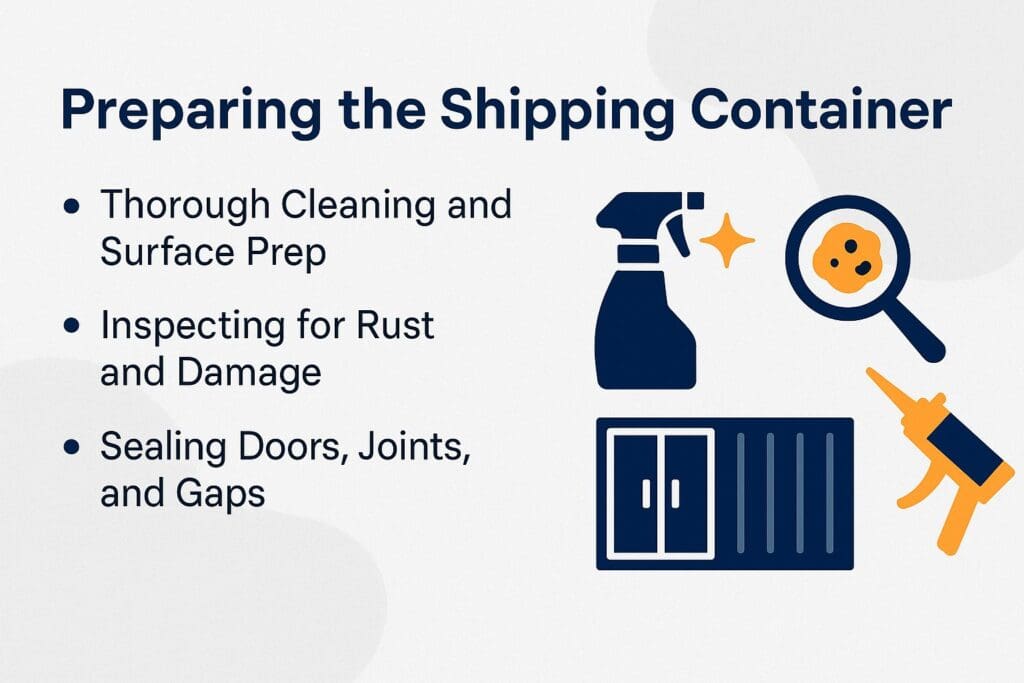
Clean your ISO container with a power washer and apply rust-proofing. This provides a solid surface for insulation and stops moisture problems in walls and floors down the line, maximizing the long-term benefits of repurposing shipping containers as outlined in our guide to hidden costs and benefits.
Thorough Cleaning and Surface Prep
Use a 2,000 PSI pressure washer ($150 rental) with TSP cleaner ($10) to degrease your container’s interior, ensuring adhesives stick without peeling.
Follow these steps for a thorough clean:
- Sweep out loose debris using a shop vac ($50) to prevent clogs during washing.
- Pressure wash walls and floor for 2-3 hours, targeting corrugations and seams where grime accumulates-wear PPE like goggles and gloves per OSHA guidelines.
- Apply degreaser like Simple Green ($8) and scrub with a wire brush ($5), letting it sit 15 minutes for oil breakdown.
- Rinse thoroughly and allow 24 hours to dry in a ventilated area to avoid trapped moisture, which can lead to mold as warned by the EPA.
- Sand rough spots with 80-grit paper ($10) for a smooth surface. Total time: 4-6 hours. This prep prevents adhesion failures, backed by ASTM standards for industrial coatings.
Inspecting for Rust and Damage
Check for rust pits deeper than 1/8 inch using a flashlight and wire brush, as untreated corrosion can compromise insulation adhesion in coastal areas.
- Look from the doors to the floor and mark any dents bigger than 2 inches. Use a tape measure for accuracy.
- Probe suspected areas with a screwdriver to detect soft spots indicating advanced corrosion.
- Treat rust promptly: Apply Rust-Oleum primer ($15/can) after sanding; for heavy pitting, sandblast first to remove flakes.
- Use a level to check the structure for straightness and lack of warping. Follow International Building Code (IBC) rules for container changes.
- Document findings with timestamped photos for insurance claims. Example: A Florida homeowner repaired salt-induced rust on a shipping container for $200, averting $1,000 in structural failure costs, per a 2022 NOAA coastal corrosion study.
This process, taking 1-2 hours, ensures long-term integrity.
Sealing Doors, Joints, and Gaps
Apply expanding foam sealant around door frames to close 1/4-inch gaps, reducing air leakage by 40% and improving energy efficiency.
To maximize results, follow these steps for effective sealing.
- First, identify gaps using a smoke test: light incense and watch for drafts near doors (per BPI standards).
- Second, clean surfaces with mild soap and a wire brush so adhesion works well. For deeper joints over 1/4-inch, insert backer rod ($10/roll from Home Depot) to support the foam.
- Third, apply low-expansion polyurethane foam like Great Stuff ($6/can), filling gaps without overfilling-trim excess after 1 hour. Weatherstrip doors with adhesive rubber seals ($20/kit).
A case study by Energy Star showed sealing a 40-foot home saved 25% on cooling costs, verified by blower door tests.
Installing Wall Insulation
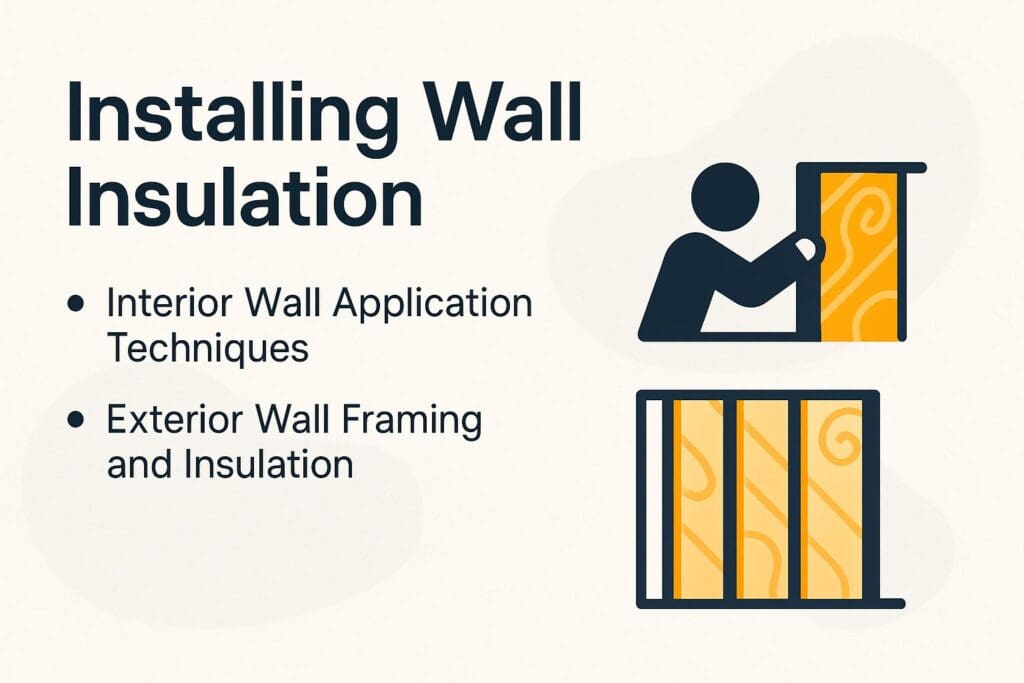
Wall insulation installation starts with framing if needed, using 2×4 wood studs spaced 16 inches on center for batts or foam boards in your container-one of the many creative uses for shipping containers besides shipping.
Interior Wall Application Techniques
For interior walls, friction-fit R-13 fiberglass batts between pressure-treated wood studs attached to container ribs with self-tapping screws.
Follow these steps for correct installation.
- Secure 2×4 top and bottom plates to the studs using 3-inch self-tapping screws every 16 inches; plates cost about $5 each at home centers like Home Depot.
- Measure and cut R-13 batts to 15.5-inch widths with a utility knife for a snug friction fit-avoid over-compressing to maintain full R-value (per ASTM C665 standards).
- Insert batts with kraft facing toward the warm interior side, stapling flanges to studs if needed.
- Cover with 1/2-inch plywood sheathing ($20 per 4×8 sheet) screwed every 6 inches.
This process insulates a 20-foot wall in 4-6 hours, reducing heat loss by up to 50% according to DOE energy studies. Wear gloves and a mask to handle fiberglass safely.
Exterior Wall Framing and Insulation
Build exterior wood framing over container walls using 2×6 lumber ($300 for 40ft) to create a rainscreen gap, then attach rigid foam boards.
- Secure the framing to the container walls every 16 inches using galvanized lag screws and anchors for stability.
- Next, fasten 3-inch thick rigid foam boards (R-15 value, $0.60/sq ft) to the framing with cap nails or foam-compatible screws, ensuring full coverage without gaps.
- Apply a layer of house wrap like Tyvek ($100/roll) over the foam to act as a moisture barrier.
- Install fiber cement siding ($400 total) as the outer cladding, overlapping seams properly.
- Flash all joints with butyl tape to seal against water.
This method boosts energy efficiency by 20-30% per DOE studies, adds 4 inches of interior space, but requires local building permits. In Florida, it’s ideal for hurricane-prone areas, enhancing wind resistance up to 150 mph.
Insulating the Ceiling and Floor
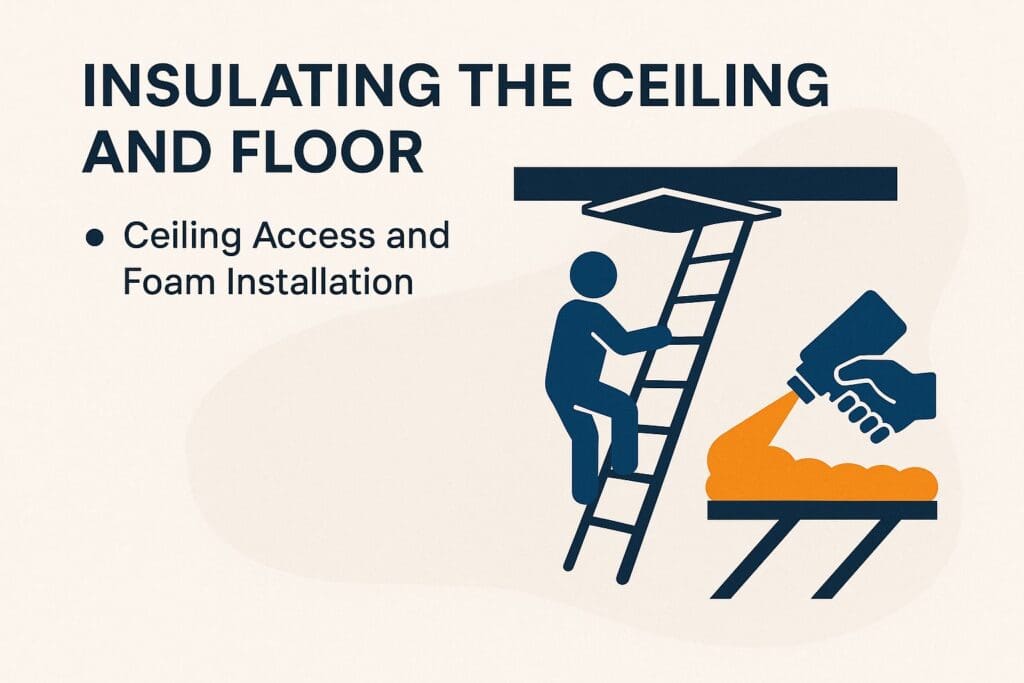
Ceiling and floor insulation requires access planning, with spray foam for ceilings and raised subfloors for floors to achieve R-30 total in extreme climates.
Ceiling Access and Foam Installation
For container conversion and storage unit modification, shipping container insulation is essential for a cargo container or ISO container, whether it’s a 20-foot container, 40-foot container, high-cube container, or standard container. Consider the container size and insulation challenges like metal conductivity of the metal skin and corrugated walls. Thermal insulation helps with heat transfer reduction, condensation prevention, humidity control, temperature control, weatherproofing, and frost protection against seasonal temperature swings. Options include cost-effective insulation, budget insulation, high-performance insulation, premium insulation, eco-friendly materials, and recycled insulation. For the container roof, roof insulation like the spray foam method provides heat gain reduction.
In sustainable storage and green building projects, focus on fire safety, pest control, durability, structural integrity, long-term durability, and corrosion protection through rust removal and priming surfaces before proceeding.
Access the ceiling via temporary scaffolding ($100 rental) to spray 6 inches of closed-cell foam with specific insulation thickness and insulation density, filling ribs for an R-39 R-value barrier against roof heat gain.
Before application, preparing container involves rust removal, priming surfaces, and welding preparation if needed. For DIY insulation or professional installation, consider quick-install methods and layering insulation. Alternatives to spray foam include EPS foam, XPS foam, rockwool, cellulose insulation, batt insulation, loose-fill insulation, using foam board adhesive, screw fasteners, and cutting insulation for wooden studs, sealing gaps with insulation tape, gap filler, and air sealing.
For the container floor, add underfloor heating and insulation. Insulate walls with paneling, and include insulated doors. Integrate electrical wiring, HVAC systems, passive solar, passive ventilation, active ventilation, solar-powered fans, and dehumidifier integration for mold prevention and humidity control.
Follow these OSHA-compliant installation steps for safe application:
- Don PPE including masks and protective clothing (respirator, gloves, coveralls) and set up exhaust fans for active ventilation to manage off-gassing fumes-poor ventilation causes 20% of DIY insulation incidents per CDC reports, ensuring fire safety.
- Drill 1-inch vent holes in closed-top ribs of the corrugated walls using a cordless drill ($50) for even expansion, while sealing gaps.
- In a 2-person team for professional installation, mix foam (e.g., BASF Spraytite kit, $300/kit) and spray steadily over 4 hours, covering 500 sq ft, focusing on interior finishing.
- Smooth with a foam rasp ($20) and add fiberglass mesh for added durability.
- Install drywall panels ($15/sheet) for finish, or consider paneling for interior finishing, maintaining structural integrity.
Total time: 6-8 hours. This method enhances heating efficiency and cooling cost savings. Lab tests by Oak Ridge National Laboratory show 30 degreesF temperature reduction, cutting cooling costs 25%, while providing overall heat gain reduction, condensation prevention, and pest control benefits for long-term durability in any container conversion.

About the Author
Written by Steve Holland, a Duke University graduate with a Master’s in Architecture. Steve is the owner of Tuff Shipping Containers, a leading container company based in North Carolina. With over 17 years of industry experience, he also serves as a contributing editor for the Tuff Shipping Containers Blog, where he shares expert insights on cold storage, custom builds, and industrial container solutions.
Leave a Reply